新聞中心

*
部落格
2026/04/07

Engineer's Selection Guide: GMSL2 vs Ethernet Camera Interface Comparison


Engineer's Selection Guide: GMSL2 vs Ethernet Camera Interface Comparison

In Vision AI system design, discussions often focus on model accuracy, resolution, and compute performance. However, field failures rarely originate from these layers. Instead, they emerge from how image data is transmitted, synchronized, and maintained across the system.

As multi-camera architectures become standard in robotics, automotive, and industrial inspection systems, the choice between GMSL2 and Ethernet is no longer a simple interface decision. It directly affects system stability, synchronization accuracy, and long-term deployment reliability.

This article examines the structural differences between these two approaches, the technical constraints engineers often overlook, and how interface selection influences system behavior in real-world environments.


System Architecture Differences: SerDes Link vs Network-Based Transmission

At a system level, GMSL2 and Ethernet represent two fundamentally different data transmission models.

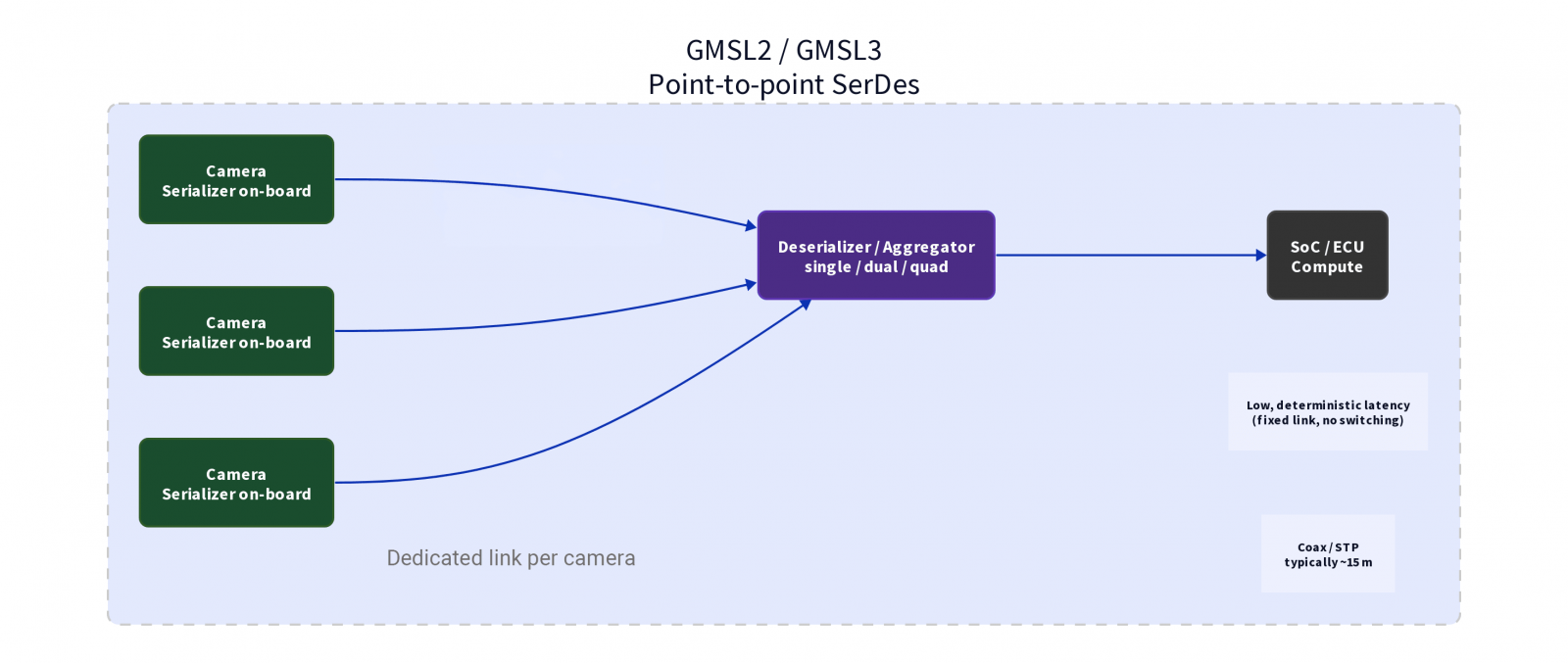
GMSL2 is built on a SerDes (Serializer/Deserializer) architecture. Image data is serialized at the camera module and transmitted through a dedicated point-to-point link. GMSL2 supports transmission rates of up to approximately 6 Gbps, while GMSL3 reaches approximately 12 Gbps, typically over coaxial or shielded twisted pair cable. Effective transmission distance reaches up to approximately 15 meters, though actual range varies depending on SerDes generation, cable quality, and system design. The transmission path is fixed, with minimal protocol overhead and predictable behavior.

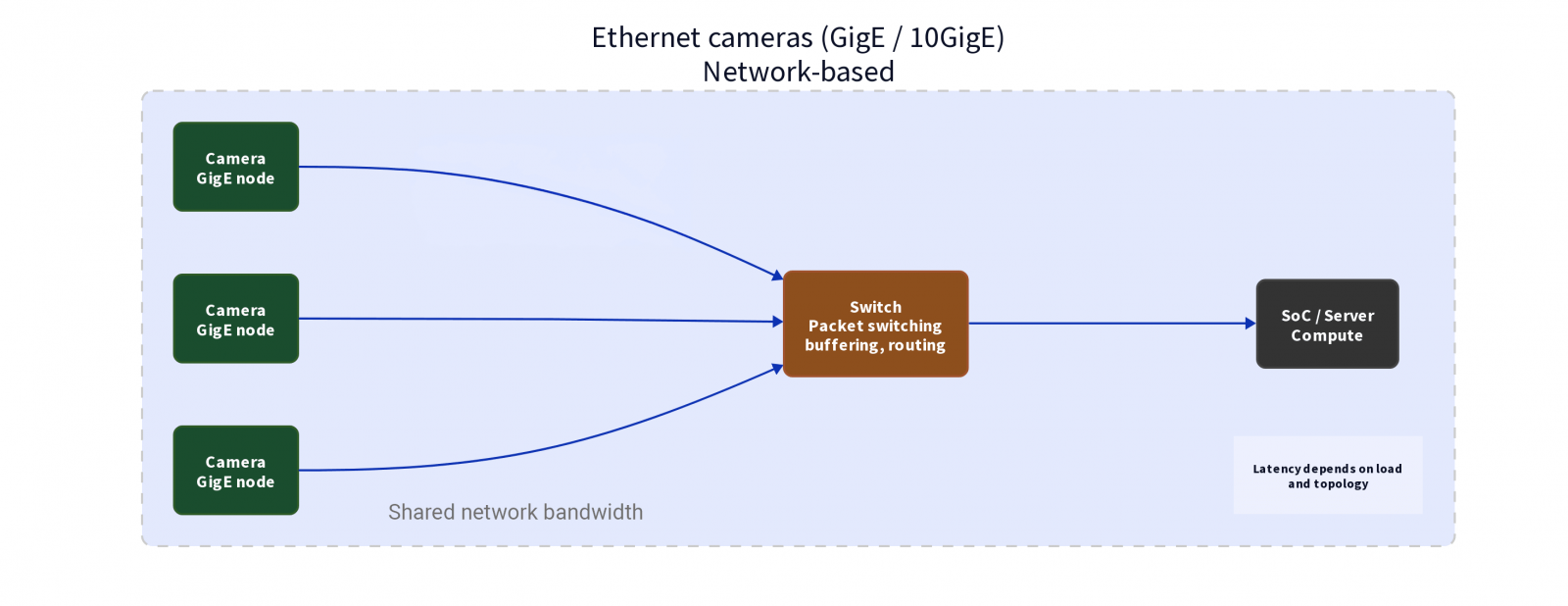
Ethernet treats image data as network traffic. Cameras act as nodes, transmitting packets through switches before reaching compute. Standard GigE supports 1 Gbps; 10GigE reaches 10 Gbps. Without repeaters, a single cable segment typically spans up to approximately 100 meters, extendable further through network equipment. The data path is dynamic and shared across devices.

This fundamental difference defines how systems scale and how data behaves under load.

Latency and Determinism: Fixed Data Path vs Network Variability

The difference in latency behavior between GMSL2 and Ethernet stems primarily from their transmission architectures.

GMSL2 provides a relatively deterministic data path. Each camera has a dedicated link, and latency typically remains in the microsecond (µs) range with low variation. This characteristic makes it well-suited for systems requiring stable timing and real-time response — such as ADAS surround view camera arrays, autonomous vehicle sensor fusion, or industrial AMR real-time visual control loops.

Ethernet introduces variability due to packetized transmission, switch buffering, and network load. In practice, latency typically falls in the sub-millisecond to millisecond range, depending on network architecture and the degree of optimization applied. Mechanisms such as QoS and Time-Sensitive Networking (TSN) can reduce this variability, but require additional system-level configuration.

In practice, systems that appear stable in lab conditions may exhibit unpredictable timing behavior once deployed.

Synchronization Challenges: Hardware Timing vs Protocol Alignment

Time synchronization is one of the most underestimated factors in multi-camera systems.

In GMSL2 architectures, synchronization is typically implemented at the hardware level — for example, through GPIO tunneling to distribute timing signals, allowing multiple sensors to share a common time reference. Under appropriate system design, microsecond-level synchronization accuracy is achievable, though actual performance depends on system configuration and hardware implementation.

Ethernet synchronization approaches vary by system design. Network-only architectures rely on PTP (IEEE 1588 Precision Time Protocol), whose accuracy is highly dependent on network equipment, topology, and hardware support across all nodes. In industrial applications, it is also common to use a dedicated M8 GPIO connector to provide hardware trigger signals, enabling multi-camera synchronization without relying on network protocols. This approach offers greater determinism than pure software-based synchronization and represents a high-precision solution within industrial Ethernet deployments.

When synchronization is misaligned, the issue rarely presents as an outright system failure. Instead, it manifests as subtle anomalies — misaligned frames, unstable object tracking, or inconsistent depth estimation. These symptoms are difficult to diagnose and are frequently misattributed to algorithm performance.

Bandwidth vs Data Flow Stability

Bandwidth is an important metric, but insufficient on its own to evaluate system performance.

In GMSL2 systems, each link is dedicated to a single camera — 6 Gbps per link for GMSL2, 12 Gbps for GMSL3 — with no contention between devices. In common designs, a single deserializer can aggregate up to four camera streams, though the actual number depends on IC design. Overall system performance still depends on the processing capacity of the backend SoC.

In Ethernet systems, bandwidth is shared. Even with 10 GigE total capacity, data streams must compete for transmission through the network. Under certain load conditions, intermittent latency spikes and brief congestion events can occur — phenomena that may not be easy to reproduce in controlled lab environments.

As a result, bandwidth availability does not guarantee stable data delivery.

Physical Layer Considerations: The Role of Interconnect Design

In high-speed imaging systems, physical interconnect design directly affects signal quality and long-term stability — yet it is often treated as a secondary concern.

In GMSL2 architectures, the signal path typically spans three stages: the board-level RF interface at the camera module, the transition layer into the transmission medium, and the coaxial or shielded twisted pair cable link connecting to the compute unit.

Each of these transition points involves impedance continuity, contact stability, and mechanical structural integrity. At transmission rates in the multi-Gbps range, even minor discontinuities or contact variation can accumulate over time and compromise signal integrity, eventually manifesting as intermittent field failures.

Ethernet systems use standardized cabling and connectors, but performance remains dependent on cable quality, shielding design, and network topology.

Connector Selection: FAKRA, Mini-FAKRA, and Industrial Ethernet Circular Connectors

In the physical layer of Vision AI systems, RF connector and industrial circular connector selection is a critical factor in signal integrity and system reliability — and one of the most commonly overlooked steps in system design. Different transmission interfaces correspond to different connector ecosystems, and incorrect selection typically does not surface until after production begins.

GMSL2/GMSL3 Systems: FAKRA and Mini-FAKRA

FAKRA is the industry standard for automotive coaxial connectivity, defined under DIN 72594-1 with color-coded classifications corresponding to different frequency ranges and application categories. In GMSL2 camera systems, FAKRA connectors handle the RF signal transition from the camera module to the wiring harness, providing reliable impedance matching (typically 50Ω) and a mechanical locking mechanism suited for high-vibration environments such as engine compartments and door modules.

Mini-FAKRA (compliant with HSD standards) is the compact evolution of FAKRA, offering approximately 40% smaller form factor while delivering comparable transmission capability at higher connector density. A single Mini-FAKRA housing can integrate up to four coaxial channels (Quad Mini-FAKRA), making it particularly suitable for space-constrained multi-camera layouts such as ADAS surround view systems or Driver Monitoring Systems (DMS).

GigE Vision Industrial Camera Systems: M12 and M8

In industrial Ethernet camera systems, the dominant physical layer configuration uses a dual-connector architecture: an M12 connector handles GigE data transmission and power delivery using PoE (Power over Ethernet) technology — transmitting both data and power over a single cable (compliant with IEC 61076-2-109, part of the GigE Vision standard) — while an M8 connector handles GPIO signals including hardware trigger input, strobe output, and bidirectional control lines (compliant with IEC 61076-2-104).

The M8 GPIO connector provides hardware-level trigger synchronization rather than relying solely on PTP-based software synchronization. For industrial vision applications requiring precise multi-camera synchronized triggering — such as high-speed production line inspection or multi-angle measurement — the signal integrity and connector reliability of the M8 trigger line directly determines synchronization accuracy.

Cross-Interface Connector Selection Considerations

Regardless of interface type — FAKRA/Mini-FAKRA or M12/M8 — physical layer connector selection involves the following common dimensions:

  • Impedance continuity: Impedance must remain consistent across connectors, cables, and PCB interfaces; any discontinuity at high frequency can cause reflection losses
  • Mechanical locking strength: Match vibration standards to the deployment environment — automotive applications reference USCAR-2; industrial environments reference the IEC 61076 series
  • IP protection rating: Outdoor or harsh environment deployments should confirm IP67 or higher
  • Transmission rate matching: GMSL3 (12 Gbps) or 10GigE systems must verify that connector and cable frequency specifications can support the corresponding signal bandwidth

Connector selection errors rarely surface during initial system testing. Instead, they appear after prolonged vibration and thermal cycling — as signal degradation or intermittent interruptions. By this point, the system may already be in production or deployed in the field, making correction extremely costly.

Environmental Reliability: Controlled Conditions vs Real Deployment

In real-world deployment environments, environmental factors often become the determining factor in system stability.

GMSL2 systems transmit over coaxial or shielded twisted pair cable with FAKRA or Mini-FAKRA locking mechanisms, providing strong EMI shielding and mechanical retention. In automotive applications, the typical operating temperature range spans approximately −40°C to +105°C, enabling stable operation under vibration, thermal variation, and electromagnetic interference.

Ethernet systems offer flexibility in cable routing and distance. Industrial deployments commonly substitute M12 connectors for standard RJ45, paired with IP67-rated enclosures to improve durability. In harsh environments, cable quality, connector retention, and shielding effectiveness remain the primary factors governing long-term reliability.

In many cases, environmental factors — not bandwidth — determine whether a system succeeds in the field.

GMSL2 vs Ethernet System Comparison

DimensionGMSL2 / GMSL3Ethernet Cameras
ArchitecturePoint-to-point, deterministicNetwork-based, distributed
Transmission Rate~6 Gbps (GMSL2) / ~12 Gbps (GMSL3)1 Gbps (GigE) / 10 Gbps (10GigE)
LatencyMicrosecond range, low variationSub-millisecond to millisecond, network-dependent
SynchronizationHardware GPIO tunneling, µs-level precisionPTP protocol or M8 GPIO hardware trigger
Bandwidth ModelDedicated per link, no inter-device contentionShared across devices
ScalabilityHardware expansion (up to 4 links/deserializer, IC-dependent)Network expansion, higher flexibility
Cable & DistanceCoax or STP, up to ~15 metersTwisted pair, ~100 meters or more
Power DeliveryPoC (Power over Coax)PoE (Power over Ethernet)
Physical ConnectorsFAKRA / Mini-FAKRAM12 (data/PoE) + M8 (GPIO)
Deployment FocusAutomotive, embedded, real-time systemsDistributed, long-range, industrial networks
Cost ProfileHigher upfront (specialized SerDes hardware)Lower upfront (standard network components)

Common Misconceptions Engineers Often Overlook

Misconception 1: Higher bandwidth guarantees better performance. The headline bandwidth gap between a ~6 Gbps GMSL2 link and 10GigE Ethernet does not translate directly into performance. Latency variation and synchronization errors can degrade system performance even when total bandwidth is sufficient.

Misconception 2: Ethernet inherently scales better. While Ethernet simplifies system expansion, it simultaneously introduces shared resources and timing variability. In multi-camera real-time systems requiring microsecond-level synchronization, scaling can actually amplify instability.

Misconception 3: Synchronization can be solved entirely in software. The real-world accuracy of PTP is constrained by hardware support and network consistency. Industrial GigE cameras can improve synchronization through M8 GPIO hardware triggering, but GMSL2's hardware GPIO tunneling still provides a lower and more stable timing baseline.

Misconception 4: Interface selection can be changed later. The architectural differences between GMSL2 and Ethernet span PCB design, wiring harness layout, connector specifications (FAKRA vs M12/M8), and driver implementation. Changing interface selection late in the design cycle typically requires re-validating the entire signal path.

Selection Considerations: Matching Interface to System Requirements

For engineers evaluating system design, the key question is not which interface is superior, but which aligns with system requirements.

Scenarios suited for GMSL2/GMSL3:

  • ADAS surround view or forward-facing cameras requiring low latency and high synchronization precision (typically achieved through hardware synchronization mechanisms)
  • Industrial AMR real-time visual control loops
  • Space-constrained embedded platforms where PoC enables single-cable integration of power, data, and control signals
  • High-EMI environments (engine compartments, welding facilities, power equipment surroundings)

Note that transmission distance is limited to approximately 15 meters (depending on cable quality and system design), and SerDes architectures typically involve specialized components and higher overall design complexity — both should be factored into system planning from the outset.

Scenarios suited for Ethernet industrial cameras:

  • Large-scale industrial vision deployments where camera-to-compute distances exceed 15 meters
  • Systems requiring integration with existing network infrastructure
  • Multi-camera synchronized triggering applications using PTP or M8 GPIO hardware triggers, such as high-speed production line inspection
  • Deployments where PoE simplifies field wiring and eliminates separate power cabling

Before making an interface decision, clearly defining system constraints — latency tolerance, synchronization precision, transmission distance, and deployment environment — is a non-negotiable step. These conditions, more than any single specification metric, determine whether a system performs reliably in the field.


FAQ

Q1: Is Ethernet always the better choice for scalable systems?
Not necessarily. While Ethernet enables flexible system expansion, it introduces shared bandwidth and packetized transmission, which can increase latency variability and synchronization complexity. In multi-camera systems, poorly managed scaling can amplify instability rather than resolve it.
Q2: Why do systems fail even when bandwidth appears sufficient?
Because bandwidth alone does not guarantee stable data delivery. Latency variation, packet jitter, and synchronization misalignment can all degrade system performance even when total throughput is adequate.
Q3: Is GMSL2 suitable for multi-camera applications?
Yes. A single GMSL2 deserializer can typically aggregate up to four camera streams in common IC designs, providing hardware-level synchronization and microsecond-range deterministic latency. Note that transmission distance is limited to approximately 15 meters depending on cable and system design — physical layout planning should account for this early.
Q4: How do I choose between FAKRA, Mini-FAKRA, M12, and M8 connectors?
Interface determines connector ecosystem: GMSL2/GMSL3 systems use FAKRA or Mini-FAKRA coaxial connectors, integrating power and signal through PoC; industrial GigE cameras use M12 (data/PoE) paired with M8 (GPIO trigger). Selection must account for impedance continuity, transmission rate compatibility, IP protection rating, and vibration durability standards.
Q5: Can synchronization be solved entirely in software?
No. The accuracy of PTP and similar protocols depends on hardware support and network consistency. Industrial GigE cameras can improve synchronization through M8 GPIO hardware triggering, but GMSL2's GPIO tunneling still provides a more stable timing baseline.
Q6: What is the most common cause of system instability in real deployments?
In most cases, instability originates from the data transmission path rather than compute performance or model accuracy. Latency fluctuations, synchronization errors, and interconnect inconsistencies accumulate over time and surface in the field — often long after initial testing is complete.

Conclusion: Interface Selection as an Architectural Decision

In modern Vision AI systems, the limiting factor is no longer model capability — it is the stability of the data pipeline.

GMSL2 and Ethernet represent two different system design philosophies. One prioritizes predictability and control; the other emphasizes flexibility and scalability. The two approaches carry distinct trade-offs in transmission distance (up to ~15m vs ~100m or more), power delivery method (PoC vs PoE), physical connector ecosystems (FAKRA/Mini-FAKRA vs M12/M8), and overall system integration complexity — all of which influence total deployment cost and timeline.

Whether a system succeeds in real-world deployment often depends on how these trade-offs are evaluated early in the design process, long before integration begins.