
Why Reliable Connectivity Matters for High-Speed Video Transmission
As camera technologies continue expanding across transportation, industrial automation, agriculture, and machine vision applications, maintaining reliable connectivity in outdoor environments has become an increasingly important design consideration.
From surround-view monitoring and blind-spot detection to machine vision and remote monitoring systems, modern platforms are relying on more cameras than ever before. However, as cameras move beyond protected enclosures and vehicle cabins, environmental exposure introduces new challenges that can directly affect system reliability.
Beyond image quality and bandwidth, long-term connectivity performance is becoming a critical factor in outdoor vision system design.
Cameras Are Moving Beyond Protected Environments
Multi-camera systems are now widely deployed across a range of outdoor applications, including:
- Commercial trucks and fleet vehicles
- Bus surveillance and safety systems
- Agricultural machinery
- Construction and heavy equipment
- Smart transportation infrastructure
- Outdoor machine vision platforms
Many of these cameras are mounted on mirrors, bumpers, roofs, trailers, equipment arms, or external enclosures where they are continuously exposed to harsh operating conditions.
What Challenges Do Outdoor Environments Create?
Water and Dust Exposure
Rain, pressure washing, dust, mud, and airborne contaminants can affect both connectivity interfaces and internal electronics if environmental protection is insufficient.
Continuous Vibration and Mechanical Stress
Commercial vehicles and heavy equipment generate constant vibration during operation. Over time, mechanical stress can affect connector retention, cable routing, and overall system reliability.
Temperature Fluctuations
Outdoor systems must withstand extreme heat, freezing temperatures, and daily thermal cycling while maintaining stable performance.
Long-Term Reliability Requirements
Many industrial and transportation systems operate continuously with limited maintenance opportunities. Reliable connectivity helps minimize downtime and reduce maintenance costs.
High-Speed Video Transmission Requires More Than Bandwidth
High-speed coaxial interfaces such as FAKRA and Mini FAKRA are widely used in camera systems to support high-resolution video transmission and multi-camera architectures.
However, when these systems are deployed outdoors, engineers must evaluate more than signal integrity and bandwidth. Additional considerations include:
- Sealed feedthrough designs
- IP-rated protection
- Secure cable routing
- Environmental durability
- Long-term serviceability
In many applications, the connection interface not only transfers data but also helps protect critical electronics from environmental exposure.
Connector Selection for Outdoor Camera Systems
Connector selection depends on interface location, signal requirements, and environmental exposure. External camera connections, sealed enclosure feedthroughs, and internal module interfaces may require different connector configurations. Engineers should evaluate the complete signal path rather than rely on an IP rating alone.
| System Requirement | Selection Considerations | Relevant ATTEND Solution |
|---|---|---|
| Outdoor vehicle camera RF connection | RF impedance, operating frequency, cable routing, environmental exposure, and mating conditions | Waterproof Mini FAKRA Connectors |
| Signal routing through a sealed enclosure | Panel mounting, enclosure sealing, and transition to internal RF modules | Mini FAKRA Waterproof Panel-Mount Assembly |
| Industrial camera and sensor interfaces | Signal interface, connector coding, locking method, and environmental protection | M12 Push-Pull Connectors, subject to interface compatibility |
| Agricultural and construction equipment camera connections | Vibration, operating temperature, cable strain relief, and sealing conditions | Mini FAKRA Cable Assemblies and FAKRA Cable Assemblies, selected according to application requirements |
For sealed camera or control-unit enclosures, ATTEND's waterproof Mini FAKRA panel-mount assembly provides a compact RF interface between external coaxial connections and internal electronic modules. IP67 protection applies under specified mating and installation conditions, while vibration resistance and system-level sealing must be evaluated separately.
Reliability Is Becoming a System-Level Requirement
As camera deployment continues to expand across commercial vehicles, agricultural machinery, construction equipment, and smart transportation systems, reliable connectivity is becoming increasingly important.
Supporting higher bandwidth remains essential, but maintaining stable operation under water, dust, vibration, and temperature extremes is equally critical.
For many outdoor vision systems, long-term reliability begins with a robust connectivity design.
Related ATTEND Connectivity Solutions
For outdoor camera and vision systems, ATTEND provides waterproof RF connectivity solutions for external camera connections, sealed enclosures, and compact electronic modules. Available product options include:
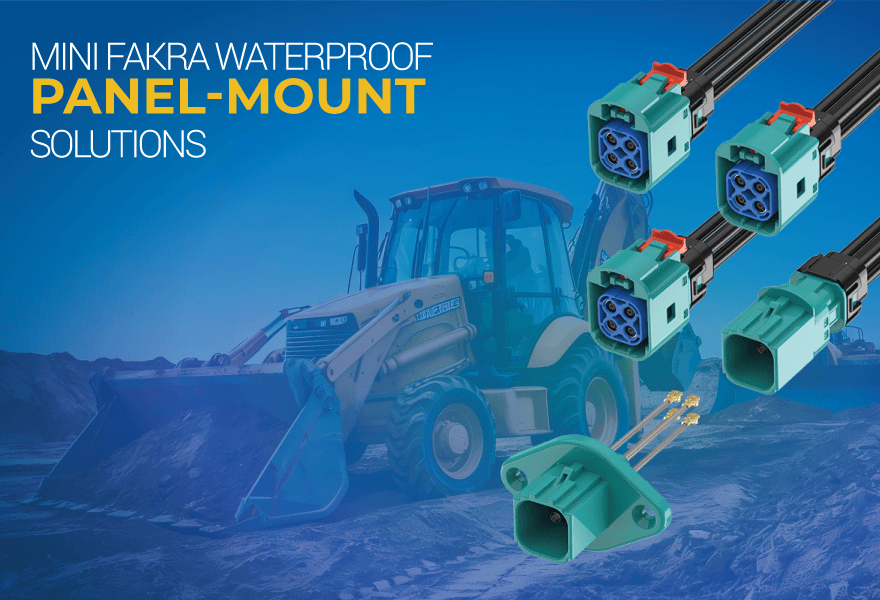
- Mini FAKRA Waterproof Panel-Mount Assemblies for sealed RF enclosure interfaces
- FAKRA Cable Assemblies for automotive and industrial coaxial connections
- Mini FAKRA Cable Assemblies for compact RF signal routing
- Waterproof Mini FAKRA Solutions with IP ratings defined by individual product and mating conditions
These solutions help engineers address environmental protection while maintaining high-speed signal integrity in demanding outdoor deployments.
| Connect with Our | CONTACT US |
Key Takeaways
- Outdoor camera systems are rapidly expanding across transportation, agriculture, construction, and industrial applications.
- Water, dust, vibration, and temperature fluctuations are common environmental challenges.
- FAKRA and Mini FAKRA are widely used for high-speed camera connectivity.
- Environmental protection should be considered alongside bandwidth and signal integrity.
- Connector selection should account for camera interfaces, enclosure sealing, and internal module connections rather than IP ratings alone.
- Reliable connectivity is essential for long-term vision system performance.
Frequently Asked Questions
Get the latest from ATTEND.Keep up to date with our latest news and analysis by subscribing to our regular newsletter. |