
Engineer's Guide to IP Rating Selection
Equipment used outdoors or in industrial environments may be exposed to moisture, dust, temperature variation, cleaning processes, chemicals, and mechanical stress in addition to electrical operating conditions. When planning connectors, enclosures, cable entries, or the complete system, engineers should first define the actual exposure: temporary immersion, prolonged immersion, water jets, high-pressure washdown, dust, or a combination of these conditions.
A higher IP code is not automatically a better engineering choice. Selecting a protection level that exceeds the real exposure may add cost and design constraints, while insufficient protection can increase the risk of ingress and field failure. This article explains how common IP codes differ, which installation details affect connector-level protection, and how engineers can match the test condition to the intended application.
Quick Answer: IP67 vs. IP68 vs. IP69K
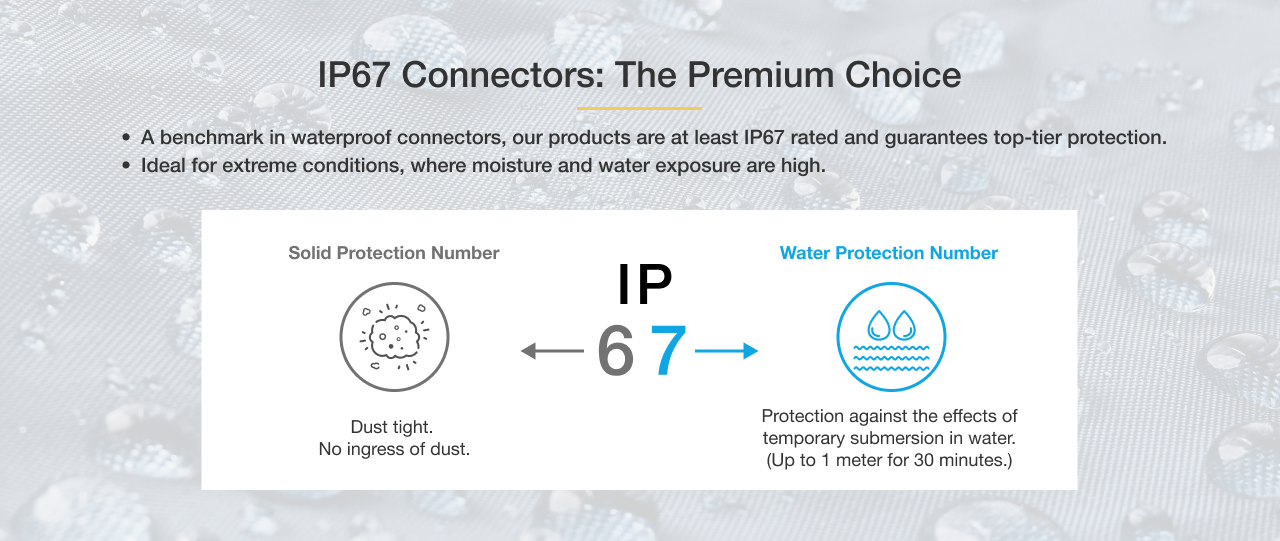
- IP67: Protection against temporary immersion under the defined IEC 60529 test condition, commonly summarized as 1 meter for 30 minutes.
- IP68: Extended or deeper immersion, with depth and duration declared by the manufacturer.
- IPX9 / IPX9K: High-pressure, high-temperature water-jet protection for washdown environments; the exact designation depends on the referenced standard.
- Selection principle: The highest number is not automatically the best choice; the test condition must match the real operating environment.
Terminology note: “IP69K” is widely used as a market-facing term. When referring specifically to ISO 20653, the formal protection code is IPX9K. This article retains “IP69K” where useful for search clarity, while distinguishing it from the formal standard designation.
IP Code Structure Analysis: How IEC 60529 Defines Dust and Water Protection
IP (Ingress Protection) codes indicate the degree of protection provided by an enclosure against solid foreign objects and water under defined test conditions. IEC 60529 uses two characteristic numerals: the first addresses protection against solid objects and dust, while the second addresses protection against water. High-pressure washdown designations such as IPX9 or IPX9K should be checked against the specific standard cited by the supplier, such as IEC 60529 or ISO 20653. These codes are not a linear performance scale; each numeral represents a different test condition.
The first digit defines dust protection capability. Level 5 means "Dust Protected," allowing minimal dust ingress without affecting functionality; Level 6 means "Dust Tight," ensuring no dust can enter any internal space. Industrial equipment and connectors typically require at least IP5X or IP6X to operate reliably in production lines or outdoor environments.
Common water-protection designations include IPX7 for temporary immersion, IPX8 for continuous immersion under conditions agreed between the manufacturer and user, and IPX9 or IPX9K for high-pressure, high-temperature washdown testing under the applicable standard. Engineers should confirm the exact test depth, duration, pressure, temperature, orientation, and product configuration stated in the supplier documentation.
The Difference Engineers Care About Most: IP67 vs IP68
When evaluating environmental protection capabilities of connectors or structural components, IP67 and IP68 are often confused, but they differ significantly in testing conditions and application scope.
IP67 is commonly used to indicate temporary-immersion protection under the defined IEC 60529 test condition, often summarized as 1 meter for 30 minutes. It may be relevant to applications where accidental or temporary immersion is a credible risk, but suitability still depends on the product configuration, installation method, operating state, and actual exposure.
Unlike IP67, IP68 does not represent one universal immersion condition. The test depth and duration must be declared by the manufacturer and defined according to the intended application. Therefore, IP68 could represent 1.5 meters for 1 hour, 3 meters for 72 hours, or another verified condition. This means different manufacturers' IP68 claims may not be directly comparable.
An IP68 design may require different sealing materials, geometry, assembly controls, or validation methods depending on the target depth, duration, medium, and operating condition. The marking alone is not enough for engineering comparison. Engineers should request the declared test depth, duration, test medium, product configuration, and verification method from the supplier.
IPX9 / IPX9K: Protection for High-Pressure, High-Temperature Washdown
High-pressure, high-temperature washdown ratings are intended for equipment exposed to close-range cleaning jets, such as selected food-processing equipment, construction vehicles, agricultural machinery, and industrial washdown systems. Suppliers may use designations such as IPX9 or IPX9K depending on the referenced standard, so the test method and standard edition should be confirmed rather than inferred from the marketing label alone.
These tests use high-pressure, high-temperature water jets at defined distances, angles, and exposure times. Exact parameters vary with the referenced standard and product category. For qualification work, engineers should use the supplier's test report and the applicable standard rather than relying on a shortened rating description.
High-pressure washdown protection does not automatically establish immersion protection. A product intended to withstand both conditions should carry separate, applicable ratings supported by the corresponding test results. Washdown and immersion evaluate different physical exposures and should be specified independently.
Product designs for high-pressure washdown may use suitable sealing geometry, overmolding, heat- and chemical-resistant materials, and secure mechanical retention. Manufacturers may also use leak, pressure, or other process-control methods according to the product design and qualification plan. No single sealing structure or production test is mandatory for every compliant design.
IP67 vs. IP68 vs. IP69K (IPX9K) Comparison Table
| Rating | Primary Test | Typical Condition | Best-Fit Applications | Immersion Protection |
|---|---|---|---|---|
| IP67 | Temporary immersion | 1 meter for 30 minutes | Outdoor equipment, industrial sensors, cameras, connectors | Yes, under the defined test condition |
| IP68 | Extended or deeper immersion | Manufacturer-declared depth and duration | Underwater equipment, long-term wet environments, customized systems | Yes, but conditions must be specified |
| IPX9 / IPX9K | High-pressure hot-water spray | High-pressure, high-temperature spray under the applicable standard | Selected food-processing, agricultural, construction, and washdown equipment | Not automatically; separate immersion testing is required |
Real-World Applications: How ATTEND Connectors Correspond to Different IP Ratings
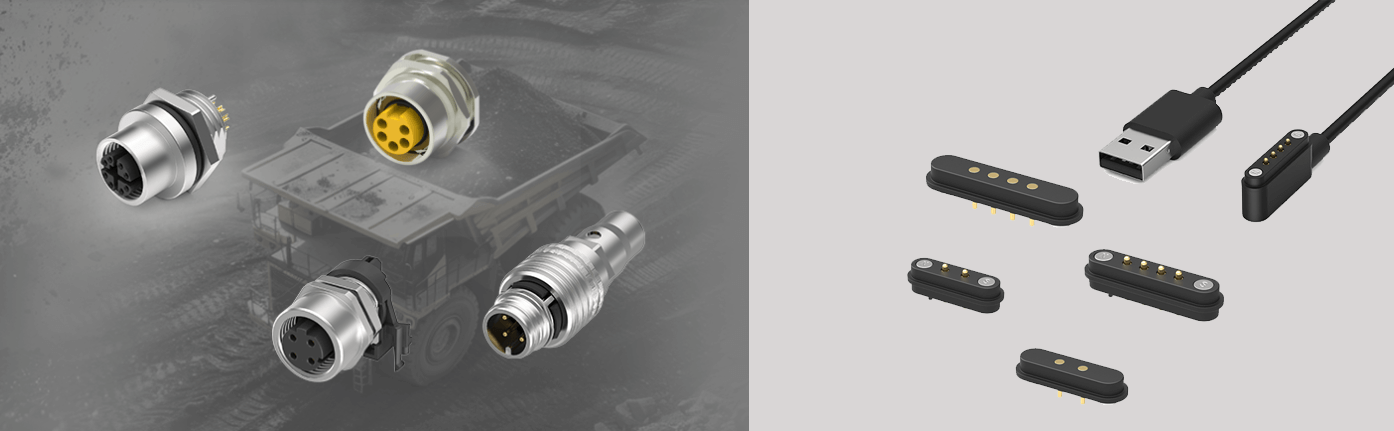
In industrial automation, selected M8 and M12 connectors and cable assemblies may be evaluated for sensors, robotic equipment, AGVs, and outdoor devices where dust, moisture, vibration, or repeated service access are design considerations. The applicable IP rating, sealing structure, cable construction, and mating condition depend on the selected part number and installation method. Product-specific immersion depth, duration, and environmental claims should be confirmed from the published specification or qualification report.
Waterproof magnetic contact solutions may be considered for selected docking, handheld, or charging interfaces where alignment and repeated mating are important. Suitability depends on the confirmed product rating, mating condition, housing design, sealing method, and cable or potting construction. Magnetic alignment can simplify engagement, but it does not by itself establish environmental protection or application suitability.
ATTEND offers connector and cable-assembly options for industrial, outdoor, and embedded applications. Selection should be based on the confirmed connector rating, cable construction, panel interface, assembly method, and complete system exposure. ATTEND can discuss these requirements with customers, but system-level protection must be validated in the final installed configuration.
ATTEND IP-Rated Interconnect Options
Connector IP Ratings Depend on Mating and Installation Conditions
For connectors, the stated IP rating may apply only when the connector is fully mated, correctly locked, and installed according to the specified panel, gasket, cable, and torque requirements. An unmated connector may require a sealing cap to maintain environmental protection.
Engineers should confirm whether the rating applies to the connector interface, panel-mounted assembly, cable assembly, or complete enclosure. Cable exits, field-installed terminations, panel cutouts, overmolding, potting, gasket compression, and assembly quality can all create potential ingress paths even when the connector body itself has passed IP testing.
Before qualification, verify the mated and unmated protection status, required accessories, installation orientation, cable outer diameter, locking method, mating frequency, and whether electrical and mechanical performance remain within specification after environmental testing.
Common Misconceptions (Technical Details Engineers Often Overlook)
Misconception 1: IP Ratings Have a Linear Hierarchy
IP codes should not be interpreted as a single linear ranking. IP66 addresses powerful water jets, while IP68 addresses continuous immersion under declared conditions. These tests represent different physical exposures and should be compared against the application rather than ranked by numeral alone.
Misconception 2: IP68 Automatically Includes IP66 Protection
An IP68 marking does not by itself document compliance with every lower-numbered water-jet test. When both immersion and jet exposure matter, confirm that the supplier has tested and declared both applicable ratings.
Misconception 3: Water Protection Equals Condensation Prevention
IP tests address external ingress under defined conditions; they do not by themselves evaluate internal condensation caused by temperature and pressure changes. Condensation control may require system-level measures such as suitable venting, sealing, material selection, drainage, or environmental control, depending on the enclosure and application.
Misconception 4: IP69K Means Prolonged Immersion Capability
High-pressure washdown protection does not automatically establish immersion protection. IPX9 or IPX9K evaluates resistance to high-pressure, high-temperature spray under the applicable standard, while IPX7 and IPX8 address immersion under different test conditions. When an application requires both washdown and immersion resistance, engineers should confirm that the supplier has separately tested and declared the applicable ratings.
IP65 vs. IP66 vs. IP67: Which Outdoor Rating Do You Need?
IP65, IP66, and IP67 address different water-exposure tests. IP65 and IP66 focus on water jets of different severity, while IP67 addresses temporary immersion. Engineers should select and verify the rating or combination of ratings that matches the real exposure rather than treating IP67 as an automatic replacement for jet testing.
Selection Guide: Appropriate IP Ratings for Different Equipment
Indoor equipment exposed to light dust or occasional splashing may use IP54 as a starting reference. General outdoor equipment commonly considers IP65, IP66, or IP67 depending on whether the primary risk is low-pressure spray, strong water jets, or temporary immersion.
Equipment with prolonged outdoor exposure, such as surveillance cameras or communication base stations, commonly selects IP66, IP67, or IP68 based on installation position and exposure conditions. Underwater devices generally require IP68, but immersion depth, duration, test medium, and operating conditions must be clearly defined.
Equipment exposed to high-pressure, high-temperature washdown may require an IPX9 or IPX9K rating under the applicable standard, while applications with immersion risk may require a separate IPX7 or IPX8 declaration. Outdoor charging and docking interfaces should be evaluated against rain, standing water, mating frequency, drainage, connector state, and complete system sealing rather than assigned a rating from the application name alone.
IP Rating Selection Reference Table
| Application Type | Commonly Evaluated Ratings | Typical Environmental Conditions | Design & Selection Priorities |
|---|---|---|---|
| Indoor Consumer Electronics (Appliances, General IT Equipment) | IP54 | Light dust, daily splashing, brief humid environments | Basic dust/splash protection sufficient, balancing cost and thermal design |
| General Outdoor Equipment (Surveillance Cameras, Outdoor IoT) | IP67 | Rain exposure, brief immersion, prolonged humidity and temperature variations | O-ring sealing, cable exit potting and harness fixation, UV and aging assessment |
| Long-term Outdoor & Underwater Equipment (Base Stations, Dock Equipment, Sensors) | IP67 / IP68, subject to declared conditions (conditions must be defined) | Extended rain exposure, standing water, possible immersion at certain depth and duration | Clearly define the IP68 immersion depth, duration, test medium, and product configuration with the supplier; sealing design and validation methods should be evaluated against those declared conditions |
| Food Processing Equipment, Construction Vehicles, Agricultural Machinery | IPX9 / IPX9K and, when required, a separate immersion rating | High-pressure hot water cleaning, detergents, oil, mud and vibration | Evaluate mechanical retention, sealing geometry, material resistance to heat and chemicals, and whether a separate immersion rating is also required |
| Outdoor Charging Stations, Industrial Handheld Terminals, Waterproof Magnetic Interfaces | IP67 / IP68 | Frequent mating/unmating, magnetic alignment, rain and humid environments | Pin and housing coordination, tolerances and deburring, cable harness overmold and potting consistency |
FAQ
- Some IP68 products might only be 1.5 meters for 30 minutes
- Others could be 3 meters for 72 hours, or customized for specific applications
- Immersion depth (how many meters)
- Immersion duration (minutes/hours/days)
- Test medium (fresh water, salt water, oil, etc.)
- IP67: Temporary immersion under the defined test condition, commonly summarized as 1 meter for 30 minutes
- IPX9 / IPX9K: High-pressure, high-temperature, close-range water jets under the applicable standard cited by the supplier
If a product carries both an applicable immersion rating and a high-pressure washdown rating, it has been tested against both conditions;
A washdown rating alone should not be interpreted as proof of immersion performance.
- Condensation from temperature differences: Day-night temperature variations or equipment heat causes internal moisture to condense into water droplets at cold points—this is outside IP testing scope.
- Long-term aging: UV, ozone, and chemical agents cause plastic components and O-rings to age and harden, reducing sealing performance.
- Mechanical stress and mating fatigue: Frequent mating/unmating, cable pulling, or impact may deform or loosen sealing surfaces.
- Improper cable harness and endpoint handling: While connector bodies pass IP testing, cable exit points, potting areas, or improper customer-end assembly can still create "water ingress paths."
IP Rating Is Only the Starting Point, Not the Endpoint
IP rating is an important reference indicator for product protection design, but it's only the starting point, not the endpoint. An IP rating verifies performance under a defined test condition; it does not by itself predict sealing performance after years of UV exposure, vibration, thermal cycling, chemical contact, or repeated mating. Factors truly affecting protection capability include: sealing design (material selection and configuration of O-rings or gaskets), material properties (heat resistance, UV resistance, chemical resistance), cable harness and terminal encapsulation processes, and pressure testing and quality control during assembly.
When planning IP ratings for connectors or housings, it's recommended to first clearly define usage scenarios: Does the product need water immersion? If so, what depth and duration? Does it need to withstand high-pressure spray? Will it encounter temperature variations or chemical corrosion? After clarifying these conditions, discuss complete testing conditions and verification reports with suppliers to ensure selection of truly appropriate protection ratings.
Need to Select IP Rating for Your Next Project?
If you are evaluating M12 connectors, waterproof magnetic contacts, panel interfaces, or outdoor cable assemblies, share the intended exposure and installation conditions with the ATTEND team. We can help review connector, cable, sealing, and assembly requirements against confirmed product specifications. Final system-level protection should be validated in the installed configuration and qualification plan.
To accelerate evaluation, provide the following project conditions:
- Required immersion depth and duration
- Water pressure, washdown temperature, and spray direction
- Operating temperature range and thermal cycling conditions
- Exposure to oil, detergent, salt water, UV, or chemicals
- Mating frequency, installation method, and mated/unmated protection needs
- Connector-only, cable assembly, panel-mount, or complete enclosure requirements